Différents types et qualités de ces monodispersés sont facilement disponibles | SINOPEG
Dans le système d'administration sophistiqué des conjugués radiopharmaceutiques (RDC), le lieur, bien qu'apparemment un simple composant auxiliaire, influe directement sur la stabilité et l'efficacité du ciblage du médicament. Le polyéthylène glycol (PEG) et ses dérivés sont des matériaux clés qui jouent ce rôle crucial.
1. Qu'est-ce que c'est : un « pont moléculaire » polyvalent
Dans la structure d'un RDC, le Liaison PEG Il agit comme un « pont ». Les médicaments RDC sont généralement composés de quatre parties : un ligand de ciblage (tel qu’un anticorps ou un peptide), un lieur, un chélateur et un radionucléide. Le lieur PEG est positionné entre le ligand de ciblage et le chélateur, les reliant pour former un médicament conjugué stable et complet.
2. Ses avantages : Pourquoi le PEG est-il si populaire ?
Le PEG est un polymère linéaire hydrophile présentant une bonne biocompatibilité. Il est intrinsèquement non toxique et non immunogène. Utilisé comme agent de liaison, il apporte plusieurs optimisations de performance clés :
Solubilité améliorée : De nombreuses molécules ou peptides de ciblage sont hydrophobes, ce qui peut affecter la préparation du médicament et son comportement in vivo. L’introduction d’une chaîne PEG hydrophile peut améliorer significativement la solubilité globale du conjugué, optimisant ainsi les propriétés pharmacocinétiques du médicament.
Durée de circulation prolongée : La chaîne PEG augmente la taille moléculaire du médicament, empêchant une filtration rénale rapide et prolongeant ainsi sa durée de circulation sanguine. Simultanément, la chaîne PEG agit comme un « camouflage », masquant la surface du médicament, réduisant sa reconnaissance et son élimination par le système immunitaire, et diminuant le risque de dégradation par diverses enzymes in vivo.
Amélioration de la stabilité et de l'efficacité du ciblage : En assurant un intervalle spatial approprié, le lien PEG réduit les interférences entre le ligand de ciblage et le chélateur ou le radionucléide. Ceci favorise une liaison plus stable et efficace du ligand à la tumeur cible. Dans le système précis des RDC, le lien PEG influe directement sur la stabilité et l'efficacité du ciblage du médicament.
3. Tendance de développement : La recherche d'un PEG « monodispersé » plus pur
À mesure que le développement des médicaments RDC progresse, les exigences de qualité relatives aux agents de liaison PEG augmentent également. Une tendance significative est le passage du PEG « polydispersé » traditionnel (dont les chaînes polymères ont des longueurs variables) au PEG « monodispersé ».
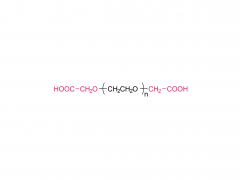
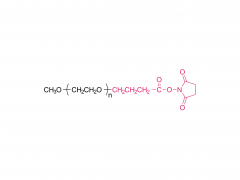
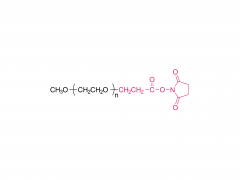
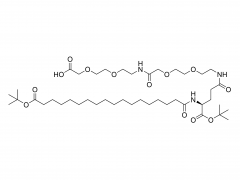
Le PEG monodispersé se caractérise par une structure bien définie, une pureté élevée et des groupements fonctionnels spécifiques à ses extrémités. Chaque segment de liaison possède ainsi une longueur de chaîne uniforme, ce qui confère aux médicaments RDC une structure plus définie et une meilleure homogénéité d'un lot à l'autre. Ceci est essentiel pour garantir la sécurité et l'efficacité du médicament. Actuellement, de nombreux médicaments RDC en phase clinique et déjà commercialisés ont bénéficié avec succès de stratégies de modification par PEG.
En résumé, bien que les liaisons PEG ne participent pas directement à la destruction des tumeurs ou à l'imagerie, elles jouent un rôle indispensable dans les médicaments RDC en optimisant la solubilité, la stabilité et le comportement in vivo, garantissant ainsi que le ligand de ciblage puisse acheminer précisément le radionucléide jusqu'à la lésion.