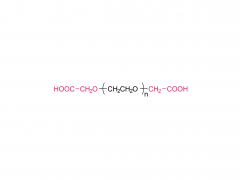
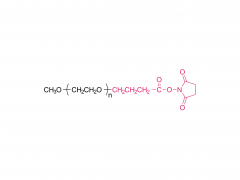
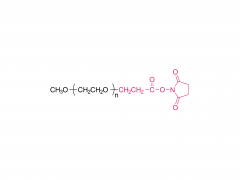
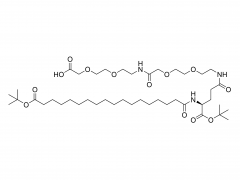
acide tert-butyloxycarbonyl-amino-polyéthylène glycol-propionique ( Boc-NH-PEGn-COOH Il s'agit d'un linker PEG fonctionnalisé comportant un groupe amino protégé (Boc) et une extrémité acide carboxylique réactive. Cette gamme de produits est disponible avec des chaînes PEG de 1 à 12 unités, et constitue un outil moléculaire clé pour la bioconjugaison et le développement de médicaments.
II. Caractéristiques structurelles
Extrémité amino : amine primaire protégée par un groupe Boc, qui peut être déprotégée en milieu acide doux pour libérer un groupe amino réactif.
Chaîne centrale : bras espaceur en polyéthylène glycol (PEG) de longueur ajustable
Extrémité acide carboxylique : Groupe carboxyle réactif capable de former des liaisons amide avec les amines
III. Principaux domaines d'application
1. Technologie PROTAC (Chimères ciblant la protéolyse)
Fonction de liaison
Dans la conception des PROTAC, le Boc-NH-PEGn-COOH joue le rôle de lien essentiel avec les fonctions suivantes :
Modulation spatiale : La chaîne PEG flexible optimise l'orientation spatiale entre le ligand de la ligase E3 et le ligand de la protéine cible
Amélioration de la solubilité : La chaîne PEG hydrophile améliore la solubilité aqueuse et la biodisponibilité des molécules PROTAC.
Synthèse modulaire : Le groupe protecteur Boc permet une déprotection sélective et une fonctionnalisation ultérieure.
Optimisation de la longueur : Différentes longueurs de PEG (n = 1–12) permettent de sélectionner la longueur de liaison optimale afin de maximiser l’efficacité de dégradation.
Avantages de l'application
Activité de dégradation améliorée : L’optimisation de la longueur du lieur peut améliorer significativement l’efficacité de la dégradation de la protéine cible.
Pharmacocinétique améliorée : la PEGylation augmente la solubilité et réduit la liaison non spécifique
Rigidité moléculaire réduite : La chaîne PEG flexible diminue les contraintes conformationnelles, facilitant la formation de complexes ternaires.
2. Chimie de la bioconjugaison
Conjugués anticorps-médicament (ADC) : association d’anticorps à des médicaments cytotoxiques
Modification des peptides et des protéines : introduction de groupes fonctionnels ou de molécules rapportrices
Fonctionnalisation de surface : Modification des nanoparticules et des surfaces de matériaux
3. Systèmes d'administration de médicaments
Conception de promédicaments : libération contrôlée via des lieurs clivables
Fonctionnalisation des nanovecteurs : amélioration du ciblage et de la biocompatibilité
4. Science des matériaux
Synthèse d'hydrogels : leur utilisation comme agent de réticulation ou monomère fonctionnel
Modification de surface : Amélioration de l’hydrophilie et de la biocompatibilité des biomatériaux
Différents types et qualités de ces monodispersés sont facilement disponibles | SINOPEG